Case study · Local service businesses · lead engine
Websites that publish, watch and report on themselves
Growing a local site takes steady work every week: new pages, getting them found, tracking what rings the phone. I built an engine that does that work on its own and sends one report on Monday morning.
- For
- Local service websites, including client sites
- Built
- Publishing, tracking and reporting engine
- Business value
- Sites that keep growing without daily upkeep
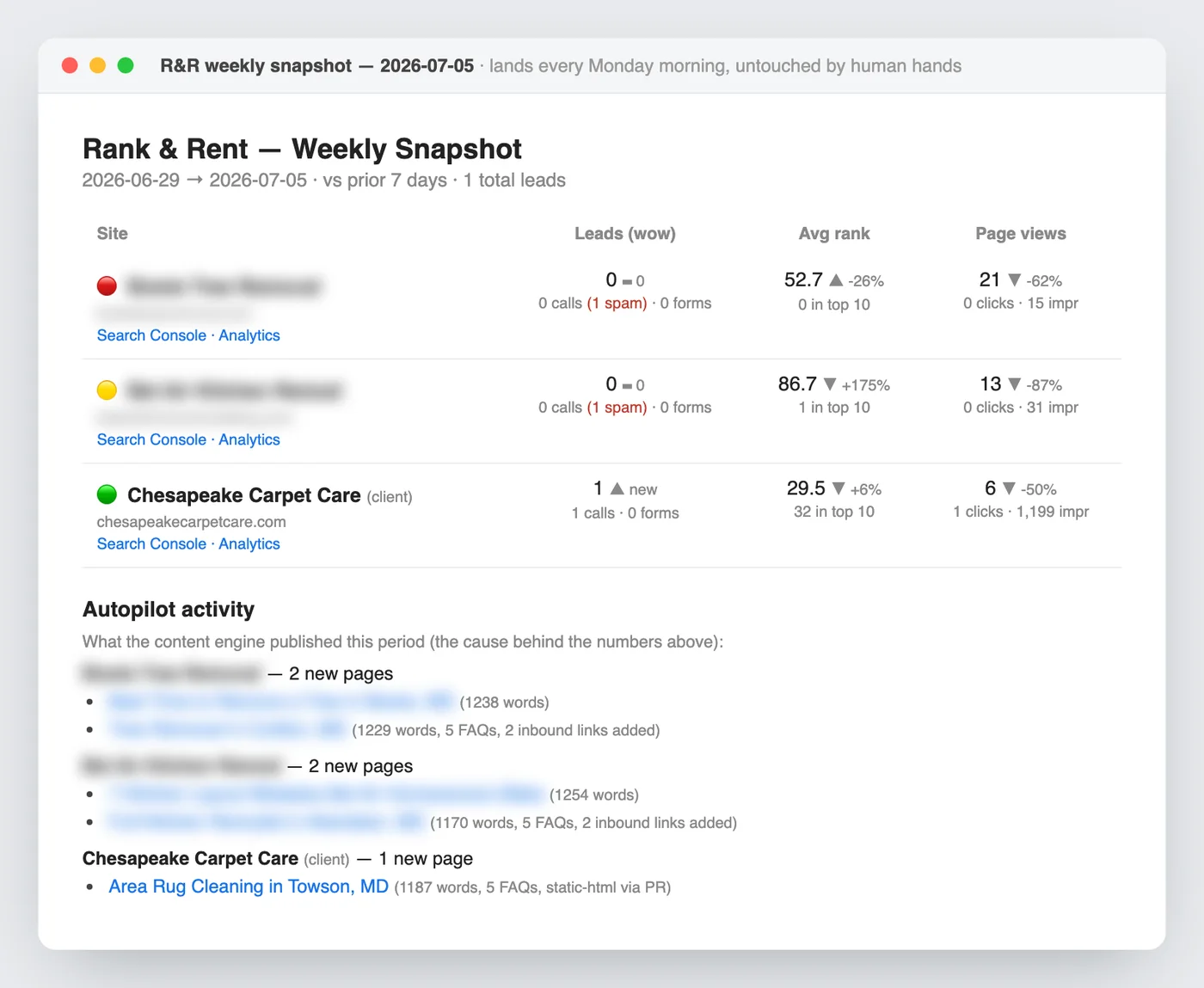
The real Monday report. Names of privately owned sites are blurred.
The problem
What wasn't working
A local website doesn't rank once and stay there. It needs new, useful pages, those pages need to get found, and someone has to notice when something breaks.
That's a few hours of steady work every week per site. Most owners don't have it, so the site goes quiet and the calls slowly dry up.
What I built
The short version
- New local pages written and published to each site every week, each one checked against an accuracy standard
- Every new page sent to Google and Bing the moment it goes live
- Tracked phone lines and forms, so every call and request is counted by site
- A Monday report, a deeper monthly one, and a daily check that stays silent unless a site breaks
How it works
Start to finish
- Step 1
Monday, before work
New pages publish to each site and get sent to the search engines, so the week starts with fresh content already submitted.
- Step 2
Then the report
One email: leads, rankings, traffic and what got indexed, per site, with a short to-do list for anything that needs a person.
- Step 3
Every day, quietly
A health check watches for a site going down or a page dropping out of Google. It only speaks up when something is wrong.
- Step 4
Every month, a second look
A deeper report, plus an audit that re-reads every published page and flags anything that isn't accurate anymore.
What was hard
The parts that took thinking
Automatic, but never careless
Pages publish on their own, so every one is checked against rules for that kind of business, and a monthly audit re-reads them all.
The owner keeps the decisions that matter
It never spends money, contacts a customer or changes a domain on its own. Those wait for a yes.
The payoff
What it does for the business
A site that keeps working
Fresh pages and new searches every week, without anyone remembering to do it.
Know what rings the phone
Calls and requests are counted per site, so spending follows what actually brings in customers.
Problems caught the same day
If a site goes down or drops out of Google, the owner hears about it that morning, not a month later.
2
new pages per site, every week
Daily
health checks, silent unless something breaks
~30 min
of owner time a week
For a business like yours
Where this fits
This fits any business whose website should be bringing in customers but nobody has time to tend it:
- A service business that serves many towns
- An owner with more than one site or location
- A team that publishes now and then and can't tell what's working
Want something like this for your business?
30 minutes, no pitch. We talk through where this would fit in your business and what it would take.
Book a free 30-minute callMore case studies
- Custom apparel shop · order intakeOrder intake: 100 emails in, one clean brief out
- Clinical research · inventoryA 33-tab spreadsheet, retired
- Short-term rentals · owner reportingEvery number in the rental business, in one place
- Carpet cleaner · website + lead trackingA 46-year-old family business, finally findable
- Shed foundation contractor · websiteA contractor that stops losing jobs to whoever looks bigger online
- Wedding DJ · website + lead trackingFrom an old WordPress page to 40 town pages
- Rentals & hospitality · guest marketingGuest Wi-Fi + email marketing. Then Airbnb banned it.
- Fantasy football · hands-off automationA fantasy football team that runs itself